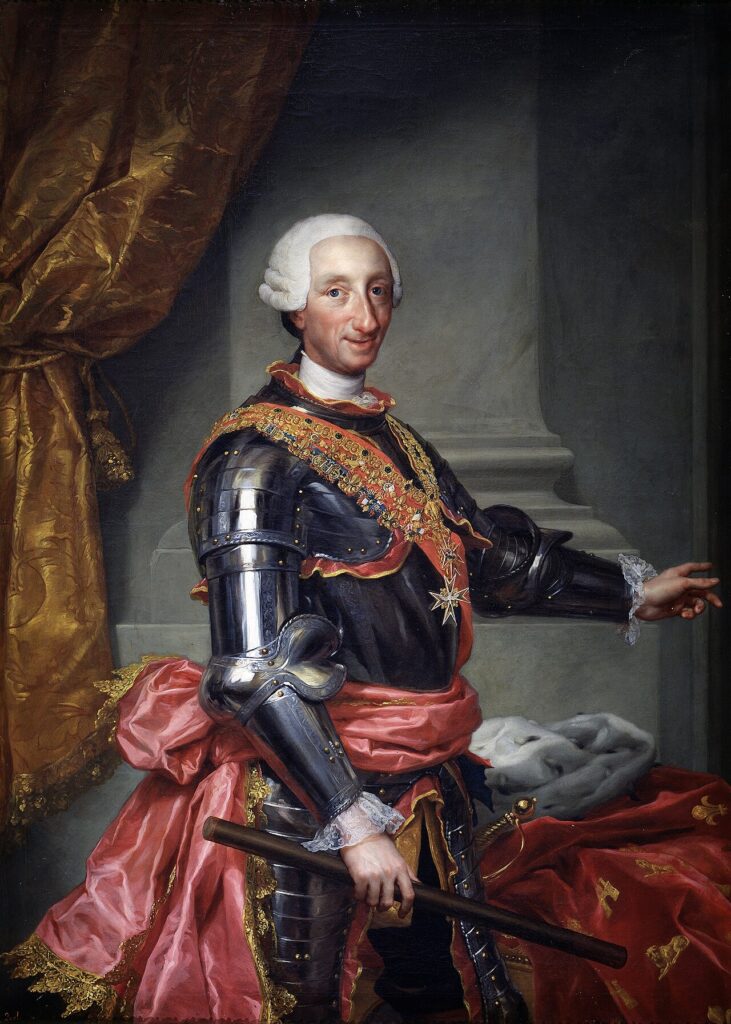
Few rulers have left a mark on Naples as profound as Charles III of Bourbon. While visitors today marvel at the city’s grand palaces, world-class opera house, and rich archaeological heritage, many are unknowingly experiencing the legacy of a monarch who transformed Naples from a peripheral possession into one of Europe’s most important capitals.
Born in 1716, Charles became King of Naples and Sicily in 1734 after defeating Austrian forces during the War of the Polish Succession. At the time, Naples was already a large and prosperous city, but it had long been governed by foreign dynasties whose rulers often resided elsewhere. Charles brought a crucial change: he chose to rule from Naples itself.
This decision elevated the city’s status dramatically. For the first time in centuries, Naples was the seat of an independent monarchy rather than a distant province of a larger empire. Charles envisioned a capital capable of rivaling Paris, Vienna, and Madrid, and he launched an ambitious program of cultural, architectural, and administrative reforms to achieve that goal.
Perhaps his most famous legacy is the Royal Palace of Caserta. Conceived as a symbol of Bourbon power, the palace was designed to compete with Europe’s greatest royal residences, including Versailles. With its vast gardens, monumental architecture, and sophisticated hydraulic system, Caserta became one of the most impressive royal complexes of the eighteenth century and remains a UNESCO World Heritage Site today.
Charles also demonstrated a strong commitment to culture and the arts. In 1737, he founded the Teatro di San Carlo, which is still the oldest continuously operating opera house in the world. The theatre quickly established Naples as one of Europe’s leading musical centers, attracting composers, performers, and aristocratic audiences from across the continent.
His influence extended beyond architecture and the arts. During his reign, systematic excavations began at Herculaneum and later at Pompeii. The discoveries captivated Europe, revealing remarkably preserved examples of Roman life and helping to inspire the Neoclassical movement. These archaeological projects not only enhanced Naples’ prestige but also transformed the study of antiquity and influenced architecture, art, and design throughout the Western world.
Charles pursued administrative reforms as well, seeking to modernize government institutions and reduce the influence of feudal structures that had long constrained economic development. Although not all of his initiatives achieved lasting success, his reign is widely regarded as a period of stability, modernization, and renewed confidence for the kingdom.
In 1759, Charles left Naples after inheriting the Spanish throne, becoming King Charles III of Spain. His departure marked the end of a transformative chapter in Neapolitan history. Yet the foundations he laid endured. The city’s royal monuments, cultural institutions, and archaeological treasures continued to shape its identity long after he had left.
Today, Charles III is remembered as one of Naples’ greatest rulers. More than a king, he was a visionary builder whose ambition elevated Naples onto the European stage. The grandeur of the city—from the halls of Caserta to the stage of San Carlo and the ruins of Pompeii—stands as a lasting testament to his remarkable influence.