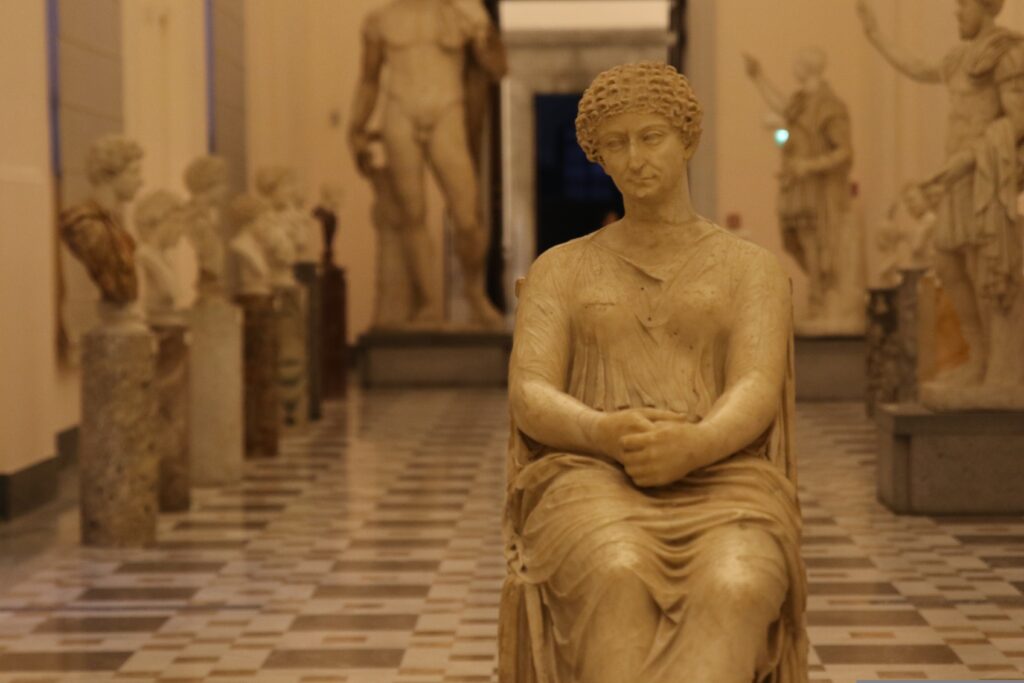
The Naples National Archaeological Museum, often called MANN from its Italian name Museo Archeologico Nazionale di Napoli, is one of the most important archaeological museums in Europe. For many travellers, it is also the missing half of a visit to Pompeii and Herculaneum. The ruins show you the streets, villas and theatres of the ancient Roman world; this museum shows you the objects, art, colour, luxury and everyday life that once filled them.
Located in central Naples, close to the Museo metro stop, the museum is not just a place for history lovers. It is one of the best ways to understand why Naples sits at the centre of so many Mediterranean stories: Greek, Roman, Bourbon, artistic, chaotic and deeply human.
Why Visit the Naples Archaeological Museum?
If you are visiting Pompeii or Herculaneum, the Naples Archaeological Museum should be high on your list. Many of the most precious mosaics, frescoes, sculptures and household objects discovered in the Vesuvian sites were moved here for preservation. That means some of the things you might expect to see inside Pompeii’s villas are actually in Naples.
The museum helps you connect the dots. Pompeii becomes more than a dramatic archaeological site; it becomes a real city where people decorated their homes, worshipped gods, cooked meals, showed off wealth, enjoyed humour, and occasionally had extremely questionable taste in home décor — very Roman, very human.
What to See Inside
The Pompeii and Herculaneum Collections
The museum’s Vesuvian collections are among its greatest treasures. Here you can see frescoes, mosaics, statues, bronzes, glassware, ceramics and everyday objects excavated from Pompeii, Herculaneum and other towns destroyed by the eruption of Mount Vesuvius in AD 79.
These rooms are especially useful if you are planning to visit Pompeii afterwards. They give context to the houses and ruins you will walk through. If you visit after Pompeii, they work almost like the “missing interiors” of the ancient city.
The Alexander Mosaic
One of the museum’s most famous works is the Alexander Mosaic, discovered in the House of the Faun in Pompeii. It shows the battle between Alexander the Great and Darius III of Persia, and it is astonishing not just for its size, but for the drama packed into tiny tesserae. It is the ancient-world equivalent of a cinematic battle scene, only made by hand, stone by stone.
The Farnese Collection
The Farnese Collection is another major reason to visit. It includes monumental sculptures collected by the powerful Farnese family, later brought to Naples by the Bourbon dynasty. The collection contains some of the museum’s most impressive classical statues and gives the museum a grandeur that goes beyond Pompeii alone. The MANN’s classical collections are built around both the Farnese holdings and discoveries from the Vesuvian sites.
The Secret Room
The museum’s Secret Room, or Gabinetto Segreto, is one of its most famous and unusual sections. It contains around 250 sexually themed objects, mainly from Pompeii and Herculaneum. For centuries, these works were hidden, restricted or treated as embarrassing because they clashed with later moral attitudes. Today, the room offers a fascinating look at Roman private life, humour, religion and social customs.
It is not just a “naughty room”, although yes, that is obviously part of the curiosity. It is also a reminder that ancient Roman culture was often far more open about sexuality, fertility and the body than later European societies.
Frescoes, Mosaics and Daily Life
Some of the museum’s most memorable exhibits are not necessarily the largest ones. Look for painted wall decorations, small domestic objects, tableware, jewellery, lamps and statues from private houses. These pieces make the ancient world feel close. A fresco from a dining room or a cooking pot from a kitchen can sometimes say more than an emperor’s marble head.
How Much Time Do You Need?
For a focused visit, allow 2 to 3 hours. This is enough to see the highlights: the Pompeii and Herculaneum material, the Farnese sculptures, the mosaics and the Secret Room.
If you are very interested in archaeology, art history or Roman life, you can easily spend 4 hours or more. The museum is large, and trying to “do it all” quickly can become museum cardio — educational, but mildly punishing.
Practical Information
The museum is located at Piazza Museo, 19, in central Naples. The easiest access is usually by metro: Museo station on Line 1 or Piazza Cavour on Line 2.
Current official opening hours are 9:00 am to 7:30 pm, with last entry at 6:30 pm. Staff begin clearing the galleries from 7:00 pm. The museum is normally closed on Tuesdays, as well as 1 January and 25 December, though special holiday rules may apply.
Online ticket purchase is recommended, especially in busy periods. The official ticketing partner notes that admission includes access to MANN and current exhibitions, with standard opening from Wednesday to Monday, 9:00 am to 7:30 pm, and last admission at 6:30 pm.
Best Time to Visit
The best time to visit is usually in the morning, when your energy is still intact and the galleries are less tiring. Another good option is late afternoon, especially if you want to pair the museum with nearby areas such as Piazza Bellini, the historic centre or Via Toledo.
Avoid squeezing it in after a full day at Pompeii unless you are highly motivated. Pompeii plus MANN in one day is possible, but it is a lot of ancient Rome for one pair of feet.
Is It Worth Visiting?
Yes — especially if you are visiting Naples for more than one day. The Naples Archaeological Museum is not just a collection of old objects. It is the place where Pompeii, Herculaneum and the ancient Bay of Naples become vivid, colourful and personal.
For travellers who want to understand Naples beyond pizza, views and street life, MANN is essential. It gives you the ancient foundations beneath the modern city: dramatic, elegant, sensual, theatrical and occasionally completely over the top. In other words, very Naples.